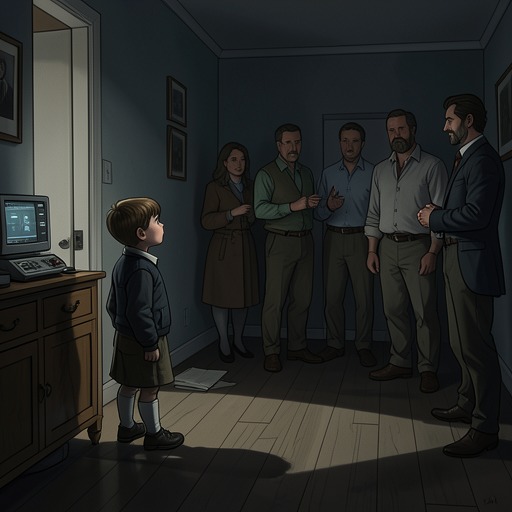
Unwelcome Guest
I'm Still Here- What didn't kill me made me stronger and sharperUnwelcome Guest is a recurring expression for Jensen Brick McCall’s experience of being kept at the margins of the places and families where he seeks belonging. It gathers together his childhood as a foster child, his ambivalent attachment to the gang he joins, and his later account of survival. Its significance changes over the story: at first, the phrase describes an identity imposed on him by other people; by the ending, it stands in contrast to a family and home he can call his own.
Identity and Origins
Jensen’s account gives the expression a material history. He recalls sleeping on library steps, being raped, living in unbearable conditions, and being unwelcome in multiple homes. People reduced him to the label foster kid, a name that marks him as someone placed in a household without being fully recognized as part of it. His recollection of attending family reunions and being introduced as the foster child taken in sharpens the injury: even in a family gathering, his status is presented as an exception that needs explaining. He feels that his name should have been simply the foster child they took in, as though the role assigned to him had displaced the possibility of an identity of his own.
The expression also describes a deeper absence than temporary accommodation. Jensen says that he wanted his mother and father and a place he could call home. He spent time in libraries and on the streets partly because photographs on household walls showed families that did not resemble him. The unwanted-guest motif therefore connects physical instability to the pain of being unable to locate himself in an ordinary image of family belonging. His experiences make the phrase more than a description of where he sleeps: it names the feeling of living among other people without being claimed by them.
Foster Care and Conditional Welcome
Jensen’s memories of foster care complicate the promise of refuge. Grace McCall, the nurse who first cared for him after a botched abortion, saved his life and raised him as her own despite resistance from her husband, family, and friends to raising a Black boy in a white world. Jensen remembers her care as genuine and decisive; she is the exception that makes the wider pattern visible. He says that he lived in ten foster homes and that, apart from Grace, the people who cared for him saw him as a guest, a burden, or a source of money.
That distinction explains why simply being placed in a home does not end his sense of exclusion. Some foster carers, he believes, treated fostering as charity, a way to receive a check, or an opportunity to appear generous at church, on television, or in the newspaper. In his account, public welcome could coexist with private rejection: he could be housed and displayed as evidence of someone else’s goodness while still feeling like an uninvited presence. The expression captures that split between being admitted into a household and being loved as one of its own.
Jensen’s birth story gives this feeling an even more painful foundation. He describes his biological mother as his murderer because, after attempting to abort him at twenty-six weeks, she was told that he had survived and instructed those caring for him to let him die. Grace intervened and saved him. Jensen connects that beginning to a sense that he had merely existed rather than truly lived, and to his search for a reason he survived. The guest motif thus reaches back to the circumstances of his birth: the person who should have welcomed him into life instead rejected him, while another woman chose to protect him.
The Search for a Substitute Family
The expression recurs in Jensen’s relationship to the .357 Murder Mafia. He joins because he wants a family: men who will have his back, shed blood for him, and never abandon him. Yet the belonging he finds there is compromised from the beginning. To remain with the group, he adapts to violence he does not want, including attacks and shootings over territory or reputation. He says that gang life made him hate looking at himself in the mirror and that what he truly wanted was neither a reputation nor control of a block, but parents and a home.
The gang’s eventual collapse makes the limits of this substitute family stark. After cooperating with Detective Dartes for weeks and supplying details, videos, and audio recordings, Jensen helps bring about the arrest of twenty-two men, including the leader. The police seize weapons, drugs, and money; the members are read their rights and taken away. Jensen describes the group as another makeshift family gone, with its members, like his foster family, on borrowed time. His cooperation is driven by his efforts to seek justice for Chyna and her son, Mortez Payne, but it also leaves him free to leave Syracuse while carrying guilt and grief. The episode exposes the contradiction at the heart of his search: a group promising loyalty can still be dangerous and temporary, and belonging obtained by conforming to violence does not give him the home he longs for.
Rewriting the Meaning of Home
Jensen’s later way of seeing other outsiders reflects what Grace’s care taught him. When he meets Janae Morrison, he recognizes hurt and a struggle to fit in beneath her defensive behavior. He tells her that she is worth caring for and compares his ability to see her worth with Grace’s ability to see his. His compassion does not erase his own history; it turns that history into a reason to offer someone else the recognition he often lacked. Inya’s offer to help Janae and her insistence that she is not bad energy likewise provide a counterpoint to the labels that have made people feel unwanted, though the support belongs to Janae’s recovery rather than changing Jensen’s past.
The story’s closing family scene reverses the image of the guest. On Christmas Day, Janae gives birth to their daughter, Grace Pearl McCall. Jensen describes himself as having a wife, a best friend, and a family, and sits at the head of a table among them. His biological mother is now his mother, having come to understand the purpose of his survival; he has also given her a kidney so that she can watch his younger brother and sister grow up. Around the same table, Mama Pearl holds her great-granddaughter and follows her tradition of placing a small crystal around each grandbaby’s neck. These details make belonging concrete: it appears in kinship, care, shared meals, and a family ritual, not merely in a claim that someone is welcome.
The expression’s movement is therefore from imposed status toward chosen and repaired relationships. Jensen does not undo the rejection, the foster-care instability, or the years in which he felt like an outsider. Instead, the ending places those experiences beside a home in which he is a husband, father, son, and brother. Survival, once bound to the question of why he was allowed to exist, becomes part of a life he shares with others.